Updated News

Browsing "Older Posts"

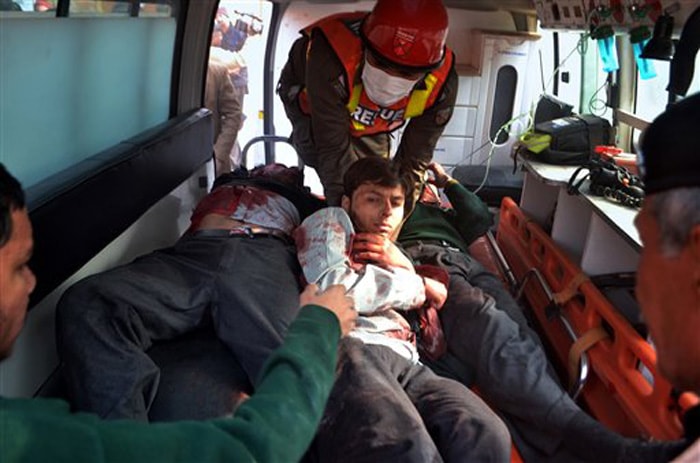
Pakistani volunteers carry a student injured in the shootout at a school under attack by Taliban gunmen, at a local hospital in Peshawar, Pakistan,Tuesday, Dec. 16, 2014. Taliban gunmen stormed a military school in the northwestern Pakistani city, killing and wounding dozens, officials said, in the latest militant violence to hit the already troubled region. (AP Photo/Mohammad Sajjad)Peshawar school attack: Pakistani volunteers carry a student injured in the shootout at a school under attack by Taliban gunmen, at a local hospital in Peshawar, Pakistan,Tuesday, Dec. 16, 2014.(AP Photo/Mohammad Sajjad)

In the deadliest slaughter of innocents in Pakistan in years, Taliban gunmen attacked a military-run school Tuesday and killed 141 people — almost all of them students — before government troops ended the siege.
The massacre of innocent children horrified a country already weary of unending terrorist attacks. Pakistan’s teenage Nobel Peace laureate Malala Yousafzai — herself a survivor of a Taliban shooting — said she was “heartbroken” by the bloodshed.
Even Taliban militants in neighboring Afghanistan decried the killing spree, calling it “un-Islamic.”
If the Pakistani Taliban extremists had hoped the attack would cause the government to ease off its military offensive that began in June in the country’s tribal region, it appeared to have the opposite effect. Prime Minister Nawaz Sharif pledged to step up the campaign that — along with U.S. drone strikes — has targeted the militants.
“The fight will continue. No one should have any doubt about it,” Sharif said. “We will take account of each and every drop of our children’s blood.”
Taliban fighters have struggled to maintain their potency in the face of the military operation. They vowed a wave of violence in response to the operation, but until Tuesday, there has only been one major attack by a splinter group near the Pakistan-India border in November. Analysts said the school siege showed that even diminished, the militant group still could inflict horrific carnage.
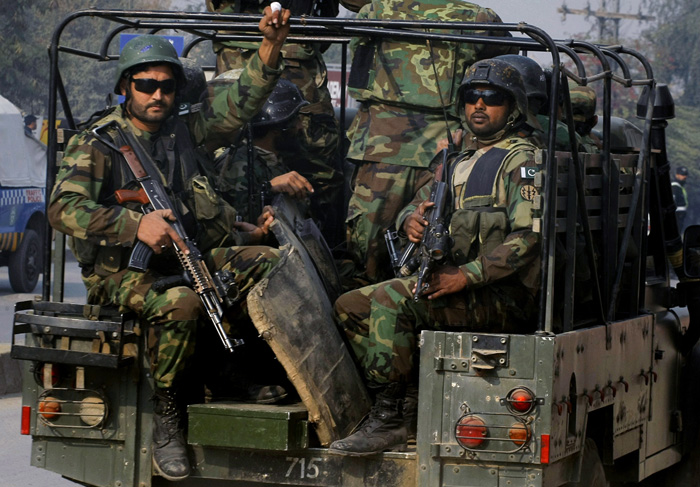
Pakistani army troops arrive to conduct an operation at a school under attack by Taliban gunmen in Peshawar, Pakistan, Tuesday, Dec. 16, 2014. (Source: Reuters) Pakistani army troops arrive to conduct an operation at a school under attack by Taliban gunmen in Peshawar, Pakistan, Tuesday, Dec. 16, 2014. (Source: Reuters)
The rampage at the Army Public School and College began in the morning when seven militants scaled a back wall using a ladder, said Maj. Gen. Asim Bajwa, a military spokesman. When they reached an auditorium where students had gathered for an event, they opened fire.
A 14-year-old, Mehran Khan, said about 400 students were in the hall when the gunmen broke through the doors and started shooting. They shot one of the teachers in the head and then set her on fire and shouted “God is great!” as she screamed, added Khan, who survived by playing dead.
From there, they went to classrooms and other parts of the school.
“Their sole purpose, it seems, was to kill those innocent kids. That’s what they did,” Bajwa said. Of the 141 people slain before government troops ended the assault eight hours later, 132 were children and nine were staff members. Another 121 students and three staff members were wounded.
The seven attackers, wearing vests of explosives, all died in the eight-hour assault. It was not immediately clear if they were all killed by the soldiers or whether they blew themselves up, he said.
A soldier escorts schoolchildren from the Army Public School that is under attack by Taliban gunmen in Peshawar, December 16, 2014.  (Reuters) A soldier escorts schoolchildren from the Army Public School that is under attack by Taliban gunmen in Peshawar, December 16, 2014. (Reuters)
The wounded — some still wearing their green school blazers — flooded into hospitals as terrified parents searched for their children. By evening, funeral services were already being held for many of the victims as clerics announced the deaths over mosque loudspeakers.
The government declared three days of mourning for what appeared to be Pakistan’s deadliest since a 2007 suicide bombing in the port city of Karachi killed 150 people.
“My son was in uniform in the morning. He is in a casket now,” wailed one parent, Tahir Ali, as he came to the hospital to collect the body of his 14-year-old son, Abdullah. “My son was my dream. My dream has been killed.”
One of the wounded students, Abdullah Jamal, said he was with a group of eighth, ninth and 10th graders who were getting first-aid instructions and training with a team of army medics when the violence became real. Panic broke out when the shooting began.
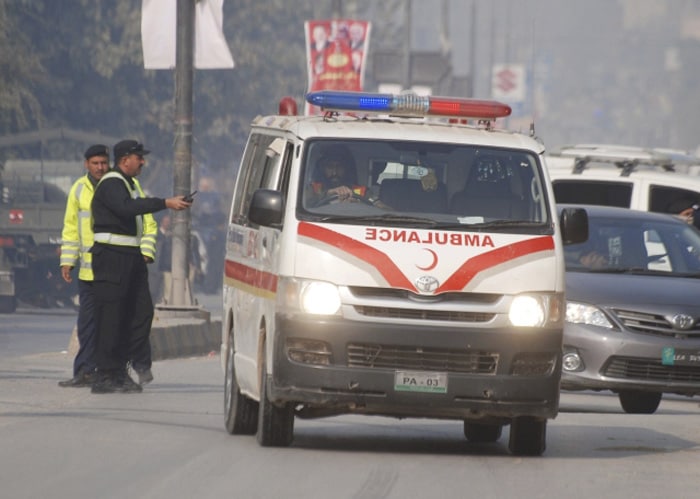
An ambulance drives away from the Army Public School that in under attack by Taliban gunmen in Peshawar, December 16, 2014. (Source: Reuters) An ambulance drives away from the Army Public School that in under attack by Taliban gunmen in Peshawar, December 16, 2014. (Source: Reuters)
“I saw children falling down who were crying and screaming. I also fell down. I learned later that I have got a bullet,” he said, speaking from his hospital bed.
Another student, Amir Mateen, said they locked the door from the inside when they heard the shooting, but gunmen blasted through anyway and opened fire.
Responding to the attack, armored personnel carriers were deployed around the school, and a military helicopter circled overhead.
Hospital staff transport a student injured in the shootout at a school under attack by Taliban gunmen in Peshawar, Pakistan,Tuesday, Dec. 16, 2014.  (Source: AP)Hospital staff transport a student injured in the shootout at a school under attack by Taliban gunmen in Peshawar, Pakistan,Tuesday, Dec. 16, 2014. (Source: AP)
A little more than 1,000 students and staff were registered at the school, which is part of a network run by the military, although the surrounding area is not heavily fortified. The student body is made up of both children of military personnel as well as civilians.
Most of the students appeared to be civilians rather than children of army staff, said Javed Khan, a government official. Analysts said the militants likely targeted the school because of its military connections.
“It’s a kind of a message that ‘we can also kill your children,'” said Pakistani analyst Zahid Hussain.
In a statement to reporters, Taliban spokesman Mohammed Khurasani claimed responsibility for the attack, saying it was retribution for the military’s operation in nearby North Waziristan, the northwestern tribal region where the group’s fighters largely have been based.
Taliban gunmen stormed a military school in the northwestern Pakistani city, killing and wounding dozens, officials said, in the latest militant violence to hit the already troubled region. (Source: AP)Taliban gunmen stormed a military school in the northwestern Pakistani city, killing and wounding dozens, officials said, in the latest militant violence to hit the already troubled region. (Source: AP)
“We targeted their kids so that they could know how it feels when they hit our kids,” Khurasani said. He said the attackers were advised not to target “underage” children but did not elaborate on what that meant.
In its offensive, the military said it would go after all militant groups operating in the region. Security officials and civilians feared retribution by militants, but Pakistan has been relatively calm.
The attack raised the issue of whether this was the last gasp of a militant group crippled by a government offensive or whether the militants could regroup.
Hussain, the Pakistani analyst, called the attack an “act of desperation.”
The violence will throw public support behind the campaign in North Waziristan, he said. It also shows that the Pakistani Taliban still maintains a strong intelligence network and remains a threat.
The attack drew swift condemnation from around the world. U.S. President Barack Obama said the “terrorists have once again showed their depravity.”
U.S. Secretary of State John Kerry added: “The images are absolutely gut-wrenching: young children carried away in ambulances, a teacher burned alive in front of the students, a house of learning turned into a house of unspeakable horror.”
Prime Minister Narendra Modi of India, Pakistan’s longtime regional rival, called it “a senseless act of unspeakable brutality.”
“My heart goes out to everyone who lost their loved ones today. We share their pain & offer our deepest condolences,” Modi said in a series of tweeted statements.
U.N. Secretary-General Ban Ki-moon said it was a “an act of horror and rank cowardice to attack defenseless children while they learn.”
The violence recalled the attack on Malala Yousafzai, who was shot in the head by a Taliban gunman outside her school in the Swat Valley for daring to speak up about girls’ rights. She survived to become a global advocate for girls’ education and received her Nobel Peace Prize last week, but has not returned to Pakistan in the two years since the shooting out of security concerns.
“Innocent children in their school have no place in horror such as this,” the 17-year-old said. “I condemn these atrocious and cowardly acts.”


Peshawar attack: 132 children among 141 killed, all 7 Taliban gunmen dead

Labels:
By: Unknown - Wednesday, 17 December 2014
Rakhi Sawant’s friend Manisha Kumari slaps director
Zee Media Bureau
Mumbai: Controversial actress Rakhi Sawant’s friend Manisha Kumari assaulted directorSachindra Sharma during the music launch of the film ‘Mumbai can’t dance sala’.
Rakhi and Sharma were on stage when Manisha slapped the director. In response, Sharma beat up Manisha on stage.
Manisha later lodged a complaint against the director accusing casting couch.
Addressing the media, Manisha said, “Sachindra Sharma...unhone mere ko compromise ke liye poocha...casting couch ke liye...aur main Rakhi ji ki friend hoon...main bahut baar inki set pe jaa chuki hoon...”. She added “uhhone mujhpar gandi nazar daali.”

Rakhi Sawant’s friend Manisha Kumari slaps director

Labels:
By: Unknown - Friday, 12 December 2014
The Reverend Jesse Jackson (L) and former Microsoft Corp Chief Executive Steve Ballmer (R) attend the annual shareholders' meeting in Bellevue, Washington December 3, 2014. REUTERS/Jason Redmond

(Reuters) - Former Microsoft Corp (MSFT.O) Chief Executive Steve Ballmer and civil rights activist Jesse Jackson livened up the technology company's annual shareholder meeting on Wednesday, grabbing the spotlight from the current leaders on stage.
Ballmer, who retired as CEO in February but is still the company's biggest individual shareholder, sat next to Jackson in the second row of the Meydenbauer Center auditorium, packed with about 400 shareholders. He chatted warmly with Jackson before and after the meeting, surrounded by well-wishers and photographers.
The famously loud Ballmer, who had several clashes with the board in his 14 years as CEO, applauded several times but was not always impressed with responses from the stage.
"That last answer sucked!" Ballmer whispered to an acquaintance, quite loudly, immediately after the meeting ended, referring to a roundabout reply by Chief Financial Officer Amy Hood.
A shareholder had asked at what price Microsoft would consider not buying back its own shares, a question on many investors' minds after the stock has risen 82 percent over the past two years to 14-year highs.
"I generally believe that our ability to grow is really only limited by our own imagination, so I tend to think the stock price over time reflects our ability to execute on that broad dream," Hood answered, dodging the direct question but effectively signaling that the shares should keep rising as long as Microsoft achieves its goals.
"Well said," new CEO Satya Nadella chimed in.
Ballmer, who stepped down from Microsoft's board in August to focus on his $2 billion purchase of the NBA's Los Angeles Clippers, is dependent on his 4 percent stake in Microsoft for the bulk of his estimated $23 billion fortune, and therefore is sensitive to the price of his shares.
But he did not ask any questions publicly at the meeting.
"As a block shareholder, the company regularly reaches out. I didn't need to use the time today," Ballmer said in an interview after the meeting.
Jackson, who met with Nadella this week, asked the company to step up its efforts to create a more diverse workforce. According to the company's latest data, its more than 100,000-strong workforce is 71 percent male and 61 percent Caucasian.
Nadella, who is Indian-born, and Chairman John Thompson, who is African-American, assured Jackson the issue was a priority for Microsoft.
(Editing by Jeffrey Benkoe and Richard Chang)

Microsoft ex-CEO Ballmer, activist Jesse Jackson pep up annual meet

Labels:
By: Unknown - Thursday, 4 December 2014
Heavy traffic moves along a busy road during a power-cut at the traffic light junctions in New Delhi July 31, 2012. REUTERS/B Mathur/Files
(Reuters) - The National Green Tribunal has banned all vehicles older than 15 years from the streets of the capital, New Delhi, in a bid to clean up air that one prominent study this year found to be the world's dirtiest.
The ruling hits up to a third of the 8.4 million motorbikes, trucks, cars and auto-rickshaws that ply the traffic-choked roads of Delhi and its surrounding areas, transport officials estimate.
Cities across the world are ordering older vehicles off the road or restricting private car use to tackle growing air pollution. Mexico City introduced a ban on older vehicles driving on Saturdays this year, while in March, France briefly enforced the most drastic traffic curbs in 20 years.
"It is undisputed and in fact unquestionable that the air pollution of ... Delhi is getting worse with each passing day," the National Green Tribunal ruled in a judgment last week banning older vehicles from city streets.
Vehicular emissions are the cause of close to three-quarters of Delhi's air pollution, the Delhi government estimates, and a World Health Organization study of 1,600 cities released in May found India's capital had the world's dirtiest air. India rejected the report.
The ban in Delhi lacks incentives to encourage drivers to trade in their older vehicles but eventually could boost sales for carmakers like Maruti Suzuki India and Tata Motors, as the capital accounts for 17 percent of India's new car sales, said IHS automotive analyst Puneet Gupta.
In Russia, sales of the Lada car have grown thanks in part to a state scheme that provides cash incentives to buy new cars if people sell their old ones for scrap.
Critics of the Delhi ruling say it is largely unenforceable, and will do little to tackle pollution in a city where 1,500 new vehicles roll onto the roads every day.
"Polluting vehicles occur in all different vintages, not just older cars," said Anumita Roychowdhury at the Delhi-based Centre for Science and Environment.
She said authorities should introduce testing of vehicles for pollution levels, and raise taxes on more polluting vehicles to discourage their use.
"You really need to scale up public transport and you need to reduce the overall volume of vehicles on the road," she said.

(Editing by Douglas Busvine and Robert Birsel)

End of the road for Delhi's old cars as India battles smog

Labels:
By: Unknown -

Google Nexus 5 encounters problems after Android update


The recent Android 5.0 Lollipop update on the Google Nexus 5 has given rise to a few problems in the functioning of the device. Android Lollipop is perhaps the most inventive software upgrade which promised a lot. The Google Nexus 5 was also one of the first few Android devices to get the Android update.
A large number of users are reportedly unhappy with the update. Post the update, users have been complaining about software bugs, connectivity issues, SMS problems as well as reduced battery backup. People online have also been complaining about issues such as overheating of the phone, apps crashing etc.
Not only third party apps, but system apps updated by Google itself are encountering these problems. Announced at Google I0 in June 2014, the updated final build OS was released only after rigorous testing and bug reporting. It has been plagued by issues despite this.
Released in the year 2013, the Google Nexus 5 was a top notch phone with features such as a 2.26 Ghz quad core Snapdragon processor, 2GB RAM . One of the main reasons for it drawing consumer attention was the assurance that Google made, promising users early access to software updates. 

Google Nexus 5 encounters problems after Android update

Labels:
By: Unknown -


Reports indicate Motorola is gearing up to release the Android 5.0 Lollipop update for the first-generation Moto G in India. Additionally, Motorola on Monday updated its 'Motorola Update Services' app in Google Play ahead of a impending Android 5.0 Lollipop update for the first-generation Moto G.
Android OS reports that the company has started sending Android 5.0 Lollipop 'soak test' invites to members of the Moto Feedback Network using a first-generation Moto G.
The invite mail reads, "Thanks for joining the Motorola Feedback Network. We are inviting owners of the Moto G in India to participate in an early preview of a new software release and provide feedback."
It's worth noting that ahead of the official release of Android 5.0 Lollipop for the Moto X (Gen 2), the company was last month testing the update with members of its Moto Feedback Network in a soak test.
Further pointing to the imminent release of the Android 5.0 Lollipop update for the first-generation Moto G, the Lenovo-owned company has updated its OTA update service app. The app update to the over-the-air (OTA) installer will enable a future upgrade to Android 5.0 Lollipop.
The app listing notes, "It updates the installer on: Moto G (1st Gen.)," and "All users with these devices should accept this update."
Motorola had in October promised the Android 5.0 Lollipop update for the Moto G alongside other devices including Moto XMoto G 4G LTEMoto EDroid UltraDroid Maxx, and Droid Mini smartphones without giving much details on timing.
Last month, the company officially announced the OTA rollout of the latest Android update for the Moto G (Gen 2) and Moto X (Gen 2) smartphones.
  • Design
  • Display
  • Software
  • Performance
  • Battery life
  • Camera
  • Value for money
  • Good
  • Excellent pricing
  • Runs Android 4.4.2, the most recent version
  • Decent specs for the price
  • Bad
  • Non-expandable storage
  • Average camera performance
Read detailed Motorola Moto G review

Android 5.0 Lollipop Update for Moto G (Gen 1) Due Soon in India: Report

Labels:
By: Unknown -
The World Food Program is launching a 72-hour campaign to raise $1 contributions from 64 million people around the world so it can restore food vouchers to 1.7 million Syrian refugees who won't be getting any U.N. help in December.
The U.N. agency announced on Monday that it was suspending aid to Syrians who fled to Jordan, Lebanon, Turkey and Egypt to escape the country's civil war because it doesn't have $64 million to cover the cost.
WFP Executive Director Ertharin Cousin said Wednesday: "We're saying to people: 'For you it's a dollar, for them it's a lifeline.'"
U.N. Deputy Secretary-General Jan Eliasson pointed to WFP's announcement as an example of the soaring increase in humanitarian needs and the international community's increasing difficulty in providing funds to help.

UN food agency campaign seeks $1 contributions from 64 million people to help Syrian refugees

Labels:
By: Unknown - Wednesday, 3 December 2014